
Peptides Explained: What They Are and What the Research Shows
Published November 16, 2026 · 11 min read
Reviewed by the Goprolean team.
Peptides are attracting attention in conversations about metabolism, cellular aging, tissue repair and sexual health. But "peptide" describes a broad category, not a single treatment with one set of benefits.
BPC-157, Epitalon, MOTS-c and PT-141 each have their own research history, and their evidence, safety considerations and regulatory status differ. Findings about one peptide do not establish the benefits of another. This guide introduces all four, explains how to read the research, and shows how Goprolean's complete care plans work.
Peptides at a glance
- Peptides are short chains of amino acids. Insulin, first used in 1922, was the first peptide medicine, and more than 80 peptide drugs have since reached the market.
- BPC-157, Epitalon and MOTS-c are studied for tissue repair, cellular aging and metabolism. In July 2026, an FDA advisory committee voted to add all three to the list of substances eligible for compounding.
- PT-141 (bremelanotide) has the strongest human evidence of the four: two phase 3 trials and a year-long extension.
- Goprolean offers each through a complete care plan with clinician evaluation, labs if needed, and medication when prescribed. Compounded medications are not FDA-approved.
What are peptides?
Peptides are short chains of amino acids, the building blocks of proteins. Many occur naturally in the body and act as signals between cells, helping to regulate processes such as metabolism, tissue repair and hormone release. Others are manufactured for research or medical use.
Peptides are not new to medicine. Insulin, introduced in 1922, was the first peptide treatment, and more than 80 peptide drugs have since reached the market for conditions including diabetes, osteoporosis and chronic pain. Researchers value peptides because they can act on specific biological targets. Wang and colleagues, 2022
The word "peptide" alone tells you little about whether a particular preparation is effective or appropriate for you. The useful questions are more specific:
- Which peptide and formulation are being considered?
- What condition or concern is it intended to address?
- Has that use been studied in people?
- What is known about its risks?
- Is the product FDA-approved or compounded?
What is peptide therapy?
Peptide therapy is the medical use of a specific peptide for a specific health goal. Because each peptide works differently, peptide therapy is not one treatment: a peptide studied for tendon healing tells you nothing about one studied for sexual desire.
That is why Goprolean offers each peptide through its own care plan, with a licensed clinician reviewing your health history, goals and medications before deciding whether a prescription is appropriate.
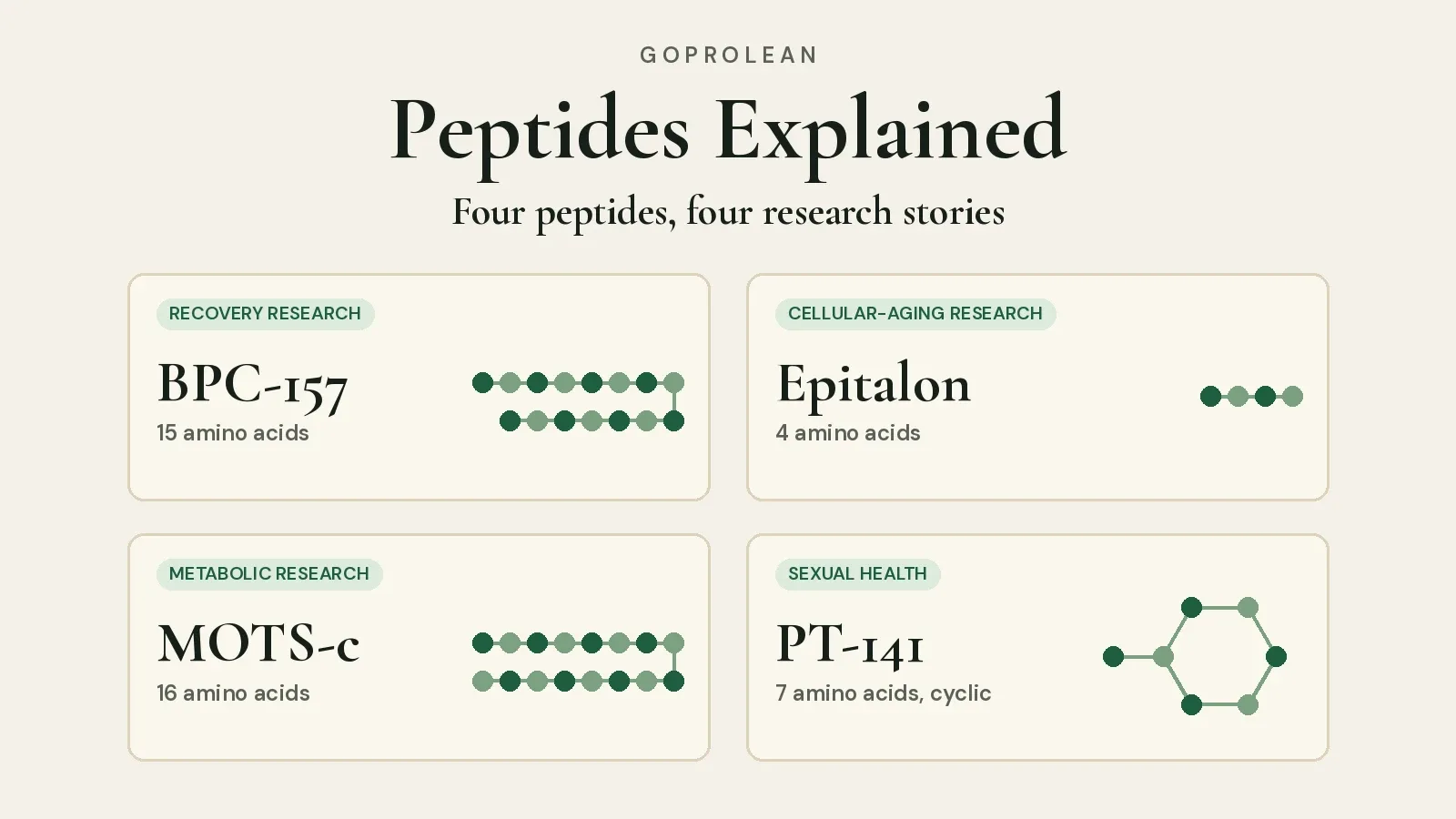
Four peptides at a glance
Four peptides, four research stories
BPC-157: tissue-repair research
BPC-157 is a synthetic peptide based on a sequence found in a protein in human gastric juice. Much of its research comes from laboratory and animal models of how tissues respond to stress and injury.
A 2025 systematic review of 36 studies found improvements in muscle, tendon, ligament and bone healing in experimental models, and concluded that BPC-157 "shows promise." Early human reports include a knee-pain study and a 2024 pilot in interstitial cystitis, in which most participants reported resolution of symptoms. Clinical benefits in humans have not yet been established in large controlled trials. FDA scientific evaluation
Read Goprolean's BPC-157 research guide.
Epitalon: cellular-aging research
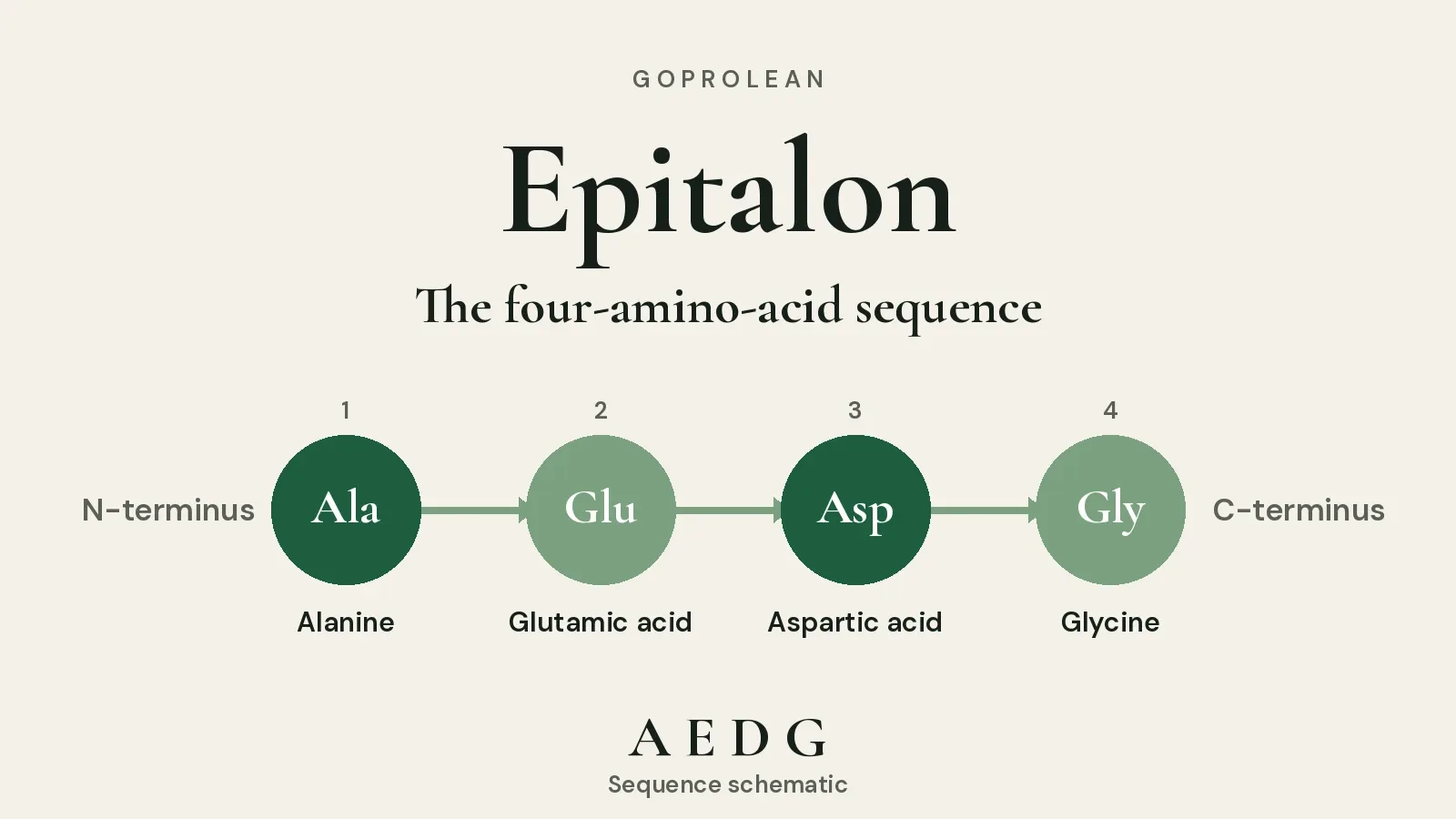
Epitalon, also spelled epithalon, is a synthetic four-amino-acid peptide studied in cellular-aging research, including telomerase and telomeres, the protective caps on chromosomes.
A 2025 laboratory study reported dose-dependent telomere lengthening in normal human cells, and a 2003 study in mice reported a longer maximum lifespan and fewer chromosome abnormalities in treated animals. These findings explain the scientific interest; they do not establish that treatment reverses aging or extends human lifespan. Epitalon should not be confused with epithalamin, a different preparation discussed in some historical research. FDA scientific evaluation
Read Goprolean's Epitalon research guide.
MOTS-c: mitochondrial and metabolic research
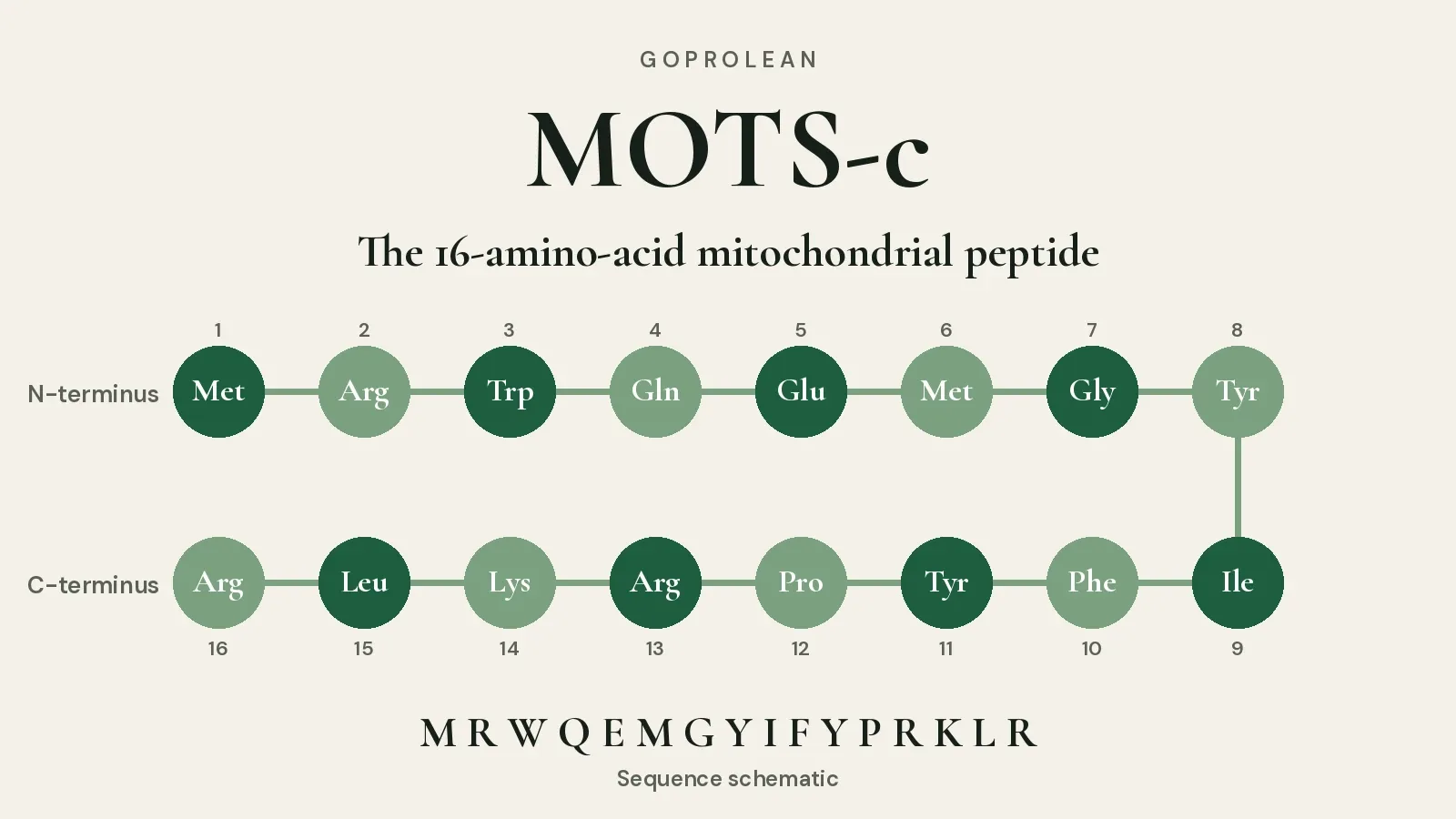
MOTS-c is a mitochondrial-derived peptide: it is encoded in the DNA of mitochondria, the energy centers of cells. Researchers study it for its role in metabolic signaling and physical capacity.
In a 2015 study, MOTS-c prevented diet-induced insulin resistance and weight gain in mice. In a 2021 study, exercise raised natural MOTS-c levels in young men, and treated older mice ran about twice as long as untreated ones. A MOTS-c analog was well tolerated in a small placebo-controlled trial in adults with obesity and fatty liver. Measuring a peptide already present in the body is different from testing the effects of giving it, and human treatment benefits have not been established. FDA scientific evaluation
Read Goprolean's MOTS-c research guide.
PT-141: bremelanotide and sexual desire
PT-141 is the development name for bremelanotide, a peptide that acts on melanocortin receptors in the brain rather than on blood flow.
In two phase 3 trials of 1,267 premenopausal women with hypoactive sexual desire disorder, bremelanotide significantly increased sexual desire and reduced related distress compared with placebo, and women in a 52-week extension showed sustained improvement. In 2019 the FDA approved a bremelanotide product for certain premenopausal women. That approval applies to the specific approved product; Goprolean's compounded PT-141 is not FDA-approved and should not be assumed equivalent to it. FDA prescribing information
How to interpret peptide research
A compelling study title is a starting point. To understand what it means for your care, look at what the researchers actually tested.
- Laboratory studies investigate cells, tissues and biological mechanisms. Even experiments using human cells are not human clinical trials.
- Animal studies help identify effects worth investigating further. Results do not automatically translate to people.
- Observational human studies examine associations. A link between a peptide level and a health measure does not prove that giving the peptide changes that measure.
- Clinical treatment trials test an intervention in people. Their value depends on design, comparison group, participant numbers, formulation, outcomes and follow-up.
Research is most relevant when the participants, preparation and intended use closely match the treatment being considered. Your clinician can help interpret those details alongside your circumstances.
Where peptide regulation stands in 2026
In July 2026, the FDA's Pharmacy Compounding Advisory Committee voted to add BPC-157, Epitalon and MOTS-c, among other peptides, to the list of bulk substances eligible for compounding. In late October 2026, HHS announced an interim policy under which compounding of BPC-157 acetate, Epitalon acetate and MOTS-c acetate may proceed under specific conditions while final decisions are made. HHS policy
That policy is not FDA approval, and it is not a blanket authorization for every formulation, combination or use. Federal enforcement discretion does not override state law, and prescribing and dispensing remain subject to state medical and pharmacy requirements.
FDA-approved and compounded medications
An FDA-approved medication has undergone the agency's review for its specified use. A compounded medication is prepared by a licensed pharmacy for an individual patient and is not FDA-approved. FDA does not review compounded drugs for safety, effectiveness or quality before marketing. Compounding can serve particular patient needs, but it does not make a preparation equivalent to an approved product. FDA information on compounded drugs
How Goprolean's complete care plans work
Goprolean is a LegitScript-certified telehealth platform connecting members with independent licensed healthcare providers.
Its medications are offered through complete care plans. The displayed price includes clinician intake and evaluation, prescribing when clinically appropriate, labs if needed, and medication when prescribed. Your clinician reviews your circumstances and decides whether a prescription is appropriate; purchasing a plan does not guarantee a prescription.
Members use the Goprolean member portal to:
- Complete their medical intake.
- Communicate with their clinicians.
- Complete the required check-in for refill requests.
When a compounded medication is prescribed, a licensed pharmacy prepares and dispenses it. Availability depends on location and clinical eligibility.
Start with your goals and the right questions
Exploring peptide care begins with what you want to address. Share your symptoms, medical history, medications and previous treatments with your clinician, and ask what evidence supports the proposed option, what alternatives exist, what risks matter for you, and how treatment would be monitored.
Goprolean brings care-plan information, individualized evaluation and ongoing communication with your clinician into one experience.
Frequently asked questions
What are peptides?
Peptides are short chains of amino acids, the building blocks of proteins. Many occur naturally in the body and act as signals between cells. Some, such as insulin, have been used as medicines for about a century.
What is peptide therapy?
Peptide therapy is the medical use of a specific peptide for a specific health goal. Each peptide has its own research, safety considerations and regulatory status, so it should be considered individually with a licensed clinician rather than as one general treatment.
Which peptides does Goprolean offer?
Goprolean offers complete care plans for BPC-157, Epitalon and MOTS-c. Each plan includes clinician evaluation, labs if needed, and medication when a licensed clinician decides it is appropriate.
Are these peptides FDA-approved?
BPC-157, Epitalon and MOTS-c are not FDA-approved. An FDA-approved bremelanotide product exists for certain premenopausal women, but Goprolean's compounded PT-141 is not FDA-approved. In July 2026, an FDA advisory committee voted to add BPC-157, Epitalon and MOTS-c to the list of substances eligible for compounding.
How do I start a peptide care plan with Goprolean?
Choose the care plan for the peptide you are interested in, then complete your medical intake in the Goprolean member portal. A licensed clinician reviews it, and if treatment is appropriate, a licensed pharmacy prepares and dispenses the medication. Purchasing a plan does not guarantee a prescription.
Explore Goprolean peptide care plans
BPC-157 care plans · Epitalon care plans · MOTS-c care plans
Medical information: This article is educational and does not provide individualized medical advice. BPC-157, Epitalon and MOTS-c are not FDA-approved, and their clinical benefits and long-term safety as treatments in humans have not been established. FDA approval of bremelanotide applies to a specific product and does not extend to compounded PT-141. Independent licensed clinicians make all prescribing decisions. LegitScript certification does not constitute FDA approval of any medication.
References
1. Wang L, Wang N, Zhang W, et al. Therapeutic peptides: current applications and future directions. Signal Transduction and Targeted Therapy. 2022;7:48. Source type: review of approved peptide drugs.
2. U.S. Food and Drug Administration. BPC-157-related bulk drug substances: scientific evaluation. July 2026 Pharmacy Compounding Advisory Committee materials.
3. U.S. Food and Drug Administration. Epitalon-related bulk drug substances: scientific evaluation. July 2026 Pharmacy Compounding Advisory Committee materials.
4. U.S. Food and Drug Administration. MOTS-c-related bulk drug substances: scientific evaluation. July 2026 Pharmacy Compounding Advisory Committee materials.
5. U.S. Food and Drug Administration. Bremelanotide injection: prescribing information. Revised October 2026.
6. U.S. Food and Drug Administration. Understanding the Risks of Compounded Drugs.
7. U.S. Department of Health and Human Services. Enforcement Discretion Policy Regarding 503A Compounding Using Certain Peptide Bulk Drug Substances.
The individual studies summarized above are cited in full in each peptide's research guide.
More in Research

November 24, 2026
How commercial peptides are safely compounded
A clear look at how compounding pharmacies prevent contamination, test for sterility and endotoxins, and signal quality for injectable peptides.
November 16, 2026
MOTS-c: Exploring the Science of Mitochondria and Metabolism
What MOTS-c research shows, from mouse metabolism and exercise studies to an early placebo-controlled trial, and how Goprolean's clinician-reviewed care plans work.
November 16, 2026
Epitalon: Understanding the Science Behind Cellular-Aging Research
What Epitalon research shows, from telomere studies in human cells to animal lifespan findings and the 2026 FDA advisory vote, and how Goprolean's care plans work.