
BPC-157: Understanding the Science Behind Recovery Research
Published November 16, 2026 · 5 min read
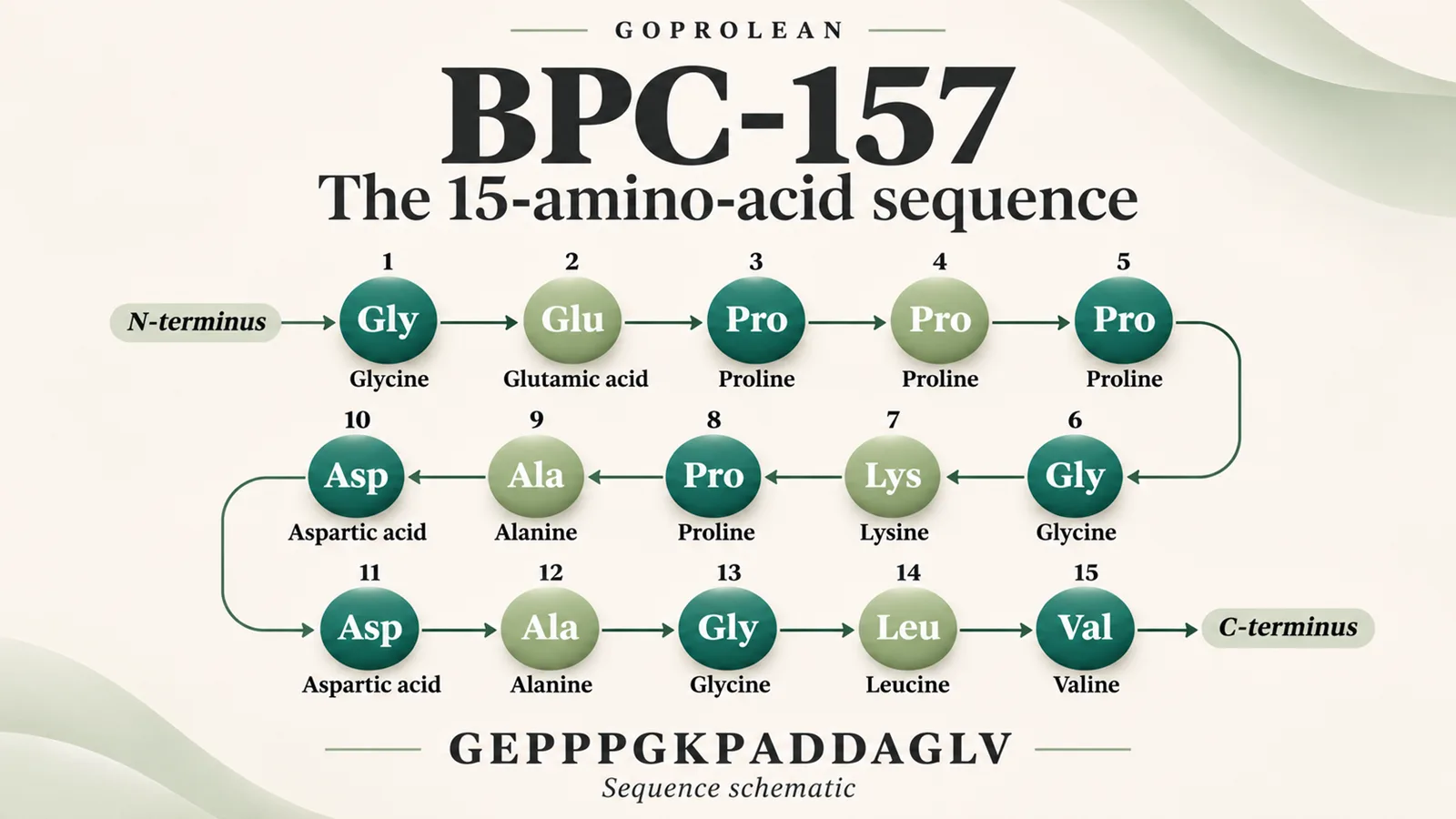
BPC-157 has attracted attention for research exploring how tissues respond to stress and injury. For people interested in recovery science, it raises an intriguing question: what have researchers discovered, and what could those findings mean for future care?
Laboratory research offers reasons to keep investigating. Human studies remain limited, however, and BPC-157 has not been established as an effective treatment for injury recovery or pain relief. It is not FDA-approved for any medical use.
This guide explains the science behind that interest and what to consider when exploring Goprolean’s clinician-reviewed care option.
Explore Goprolean’s BPC-157 care plans and evaluation process →
What is BPC-157?
BPC-157 is a synthetic peptide made up of 15 amino acids. Peptides are short chains of amino acids, the building blocks of proteins.
Researchers have investigated BPC-157 in tissue-injury and gastrointestinal research. Much of that work takes place in laboratory and animal models, which help scientists identify biological effects worth studying further. They do not, by themselves, establish that a treatment works in people. FDA scientific review
For someone researching BPC-157, the useful question is: What does the evidence suggest, and what would we still need to know before expecting a particular result?
Why is BPC-157 being studied for recovery?
Tissue repair depends on coordinated activity among cells and the signals that influence how they move, survive, and respond to injury. BPC-157 research has examined several of these processes.
In a 2011 laboratory study using rat tendon tissue and cells, researchers observed increased tendon-cell outgrowth, cell migration, and survival under experimental stress after exposure to BPC-157. These findings help explain the scientific interest in its biological activity. They did not establish faster healing or pain relief in human patients. Chang and colleagues, 2011
A separate laboratory study examined growth hormone receptor expression in rat tendon fibroblasts. Its findings offered another possible mechanism for investigation, rather than evidence of a clinical benefit in people. Chang and colleagues, 2014
Together, these studies provide a foundation for further research. Understanding their limits helps you have a more informed conversation with a clinician about your goals, symptoms, and available care options.
What do human studies tell us?
Human research on BPC-157 is much more limited than laboratory and animal research.
A small retrospective study examined people who had received injections into the knee containing BPC-157, either alone or with another peptide. Participants reported improvements, making the study a starting point for further investigation. However, it lacked a control group and relied on a small sample and retrospective reporting. It could not establish that BPC-157 caused the improvements. Findings from injections into a joint also cannot automatically be applied to other routes of administration. Original knee-pain study
For readers exploring potential BPC-157 benefits, the takeaway is straightforward: early observations can guide research, but they do not establish faster healing, reliable pain relief, or a predictable recovery timeline.
A useful clinical conversation starts with your goals and an honest discussion of the evidence.
Exploring BPC-157 through Goprolean
Goprolean is a LegitScript-certified telehealth platform connecting members with independent licensed healthcare providers. Its BPC-157 offering is presented as a complete care plan, with the displayed price covering physician intake and evaluation, prescribing when clinically appropriate, labs if needed, and medication when prescribed.
You can review the current options on the Goprolean BPC-157 care-plan page. A provider determines whether a prescription is appropriate after reviewing your individual circumstances; purchasing a plan does not guarantee a prescription.
Your care continues through the Goprolean member portal:
- Complete your intake: Share your medical history, symptoms, current medications, and treatment goals.
- Communicate with your providers: Ask questions and discuss your care through the portal.
- Check in for refills: Return to the portal for the required refill check-in and provider review.
When a compounded medication is prescribed, it is prepared and dispensed by a licensed pharmacy. Eligibility and availability vary by location and clinical circumstances.
View BPC-157 care-plan details →
BPC-157 safety and current compounding considerations
BPC-157’s human safety profile, including long-term effects, remains incompletely characterized. FDA scientific reviewers have identified gaps in the evidence and potential concerns involving immune reactions and peptide-related impurities. FDA scientific review
The HHS interim enforcement-discretion policy specifically addresses BPC-157 acetate, subject to conditions concerning formulation, route of administration, ingredient quality, patient-specific prescriptions, and other requirements. Those conditions include a single active pharmaceutical ingredient. This policy is not FDA approval or a finding that BPC-157 is safe and effective. HHS compounding policy
Compounded medications are not FDA-approved. Clinical evaluation gives you an opportunity to discuss the evidence, uncertainties, alternatives, and monitoring appropriate to your situation.
Explore your next step with Goprolean
BPC-157 research is part of an evolving scientific conversation about tissue repair. Knowing what has been studied—and what remains unanswered—helps you approach that conversation with clearer expectations.
Goprolean brings plan information, clinician evaluation, and ongoing provider communication into one care experience. Explore the BPC-157 offering, review what the complete care plan includes, and use the member portal to share your history and questions with your provider.
Explore Goprolean’s BPC-157 complete care plans →
Medical information: This article is educational and does not provide individualized medical advice. BPC-157 is not FDA-approved, and its clinical benefits and long-term safety in humans have not been established. All prescribing decisions rest with independent licensed clinicians. Goprolean’s LegitScript certification does not constitute FDA approval of any medication. Availability depends on location and clinical eligibility.
References and further reading
The sources below include original laboratory research, small human studies, and government reviews. Laboratory findings and preliminary human observations do not establish clinical effectiveness or long-term safety.
-
Chang CH, Tsai WC, Lin MS, Hsu YH, Pang JH. The promoting effect of pentadecapeptide BPC 157 on tendon healing involves tendon outgrowth, cell survival, and cell migration. Journal of Applied Physiology. 2011;110(3):774–780. doi:10.1152/japplphysiol.00945.2010. Evidence type: laboratory tendon tissue and cell study.
-
Chang CH, Tsai WC, Hsu YH, Pang JHS. Pentadecapeptide BPC 157 Enhances the Growth Hormone Receptor Expression in Tendon Fibroblasts. Molecules. 2014;19(11):19066–19077. doi:10.3390/molecules191119066. Evidence type: laboratory study of rat tendon fibroblasts; further reading on potential mechanisms.
-
Lee E, Padgett B. Intra-Articular Injection of BPC 157 for Multiple Types of Knee Pain. Alternative Therapies in Health and Medicine. 2021;27(4):8–13. PMID:34324435. Evidence type: small retrospective human study without a control group.
-
Lee E, Burgess K. Safety of Intravenous Infusion of BPC157 in Humans: A Pilot Study. Alternative Therapies in Health and Medicine. 2025;31(5):20–24. PMID:40131143. Evidence type: two-participant human pilot study; insufficient to establish general or long-term safety, or safety by other routes.
-
U.S. Food and Drug Administration. Evaluation of BPC-157-Related Bulk Drug Substances: Pharmacy Compounding Advisory Committee Briefing Document. July 23–24, 2026 meeting. Source type: scientific and regulatory review; meeting materials are not a final approval decision.
-
U.S. Department of Health and Human Services. HHS Enforcement Discretion Policy Regarding 503A Compounding Using Certain Peptide Bulk Drug Substances. Source type: interim compounding policy; enforcement discretion is not FDA approval.
More in Research

October 20, 2026
Stopping GLP-1: What to Expect for Weight, Appetite, and Labs
Research shows drug clearance, biology and behavior all matter when you stop GLP-1 medications. This guide explains timing, appetite return, metabolic markers and practical defenses.

October 8, 2026
Longevity Myths: What If the Headline Was Never in the Study?
Most longevity myths start with a real study. Follow one from the lab to the headline, then use five questions on any claim you read, including ours. Part of our series on aging.

October 8, 2026
Longevity Medicine: What If You Started With What You Want to Change?
Longevity medicine is not one treatment. It is seven, and each answers a different question. What each one is, what the studies show, who it suits and what it costs. The guide to our series on aging.