
MOTS-c: Exploring the Science of Mitochondria and Metabolism
Published November 16, 2026 · 10 min read
Reviewed by the Goprolean team.
Mitochondria do more than help cells produce energy. They also send signals to the rest of the cell, and researchers are investigating how those signals relate to metabolism, exercise and aging.
MOTS-c is part of that scientific conversation. This small peptide has attracted interest through studies of glucose regulation, insulin sensitivity, physical performance and cellular stress responses.
For people exploring emerging peptide options, the research offers a window into a developing field. MOTS-c is not FDA-approved, and its benefits and long-term safety as a treatment in humans have not been established.
Key facts about MOTS-c
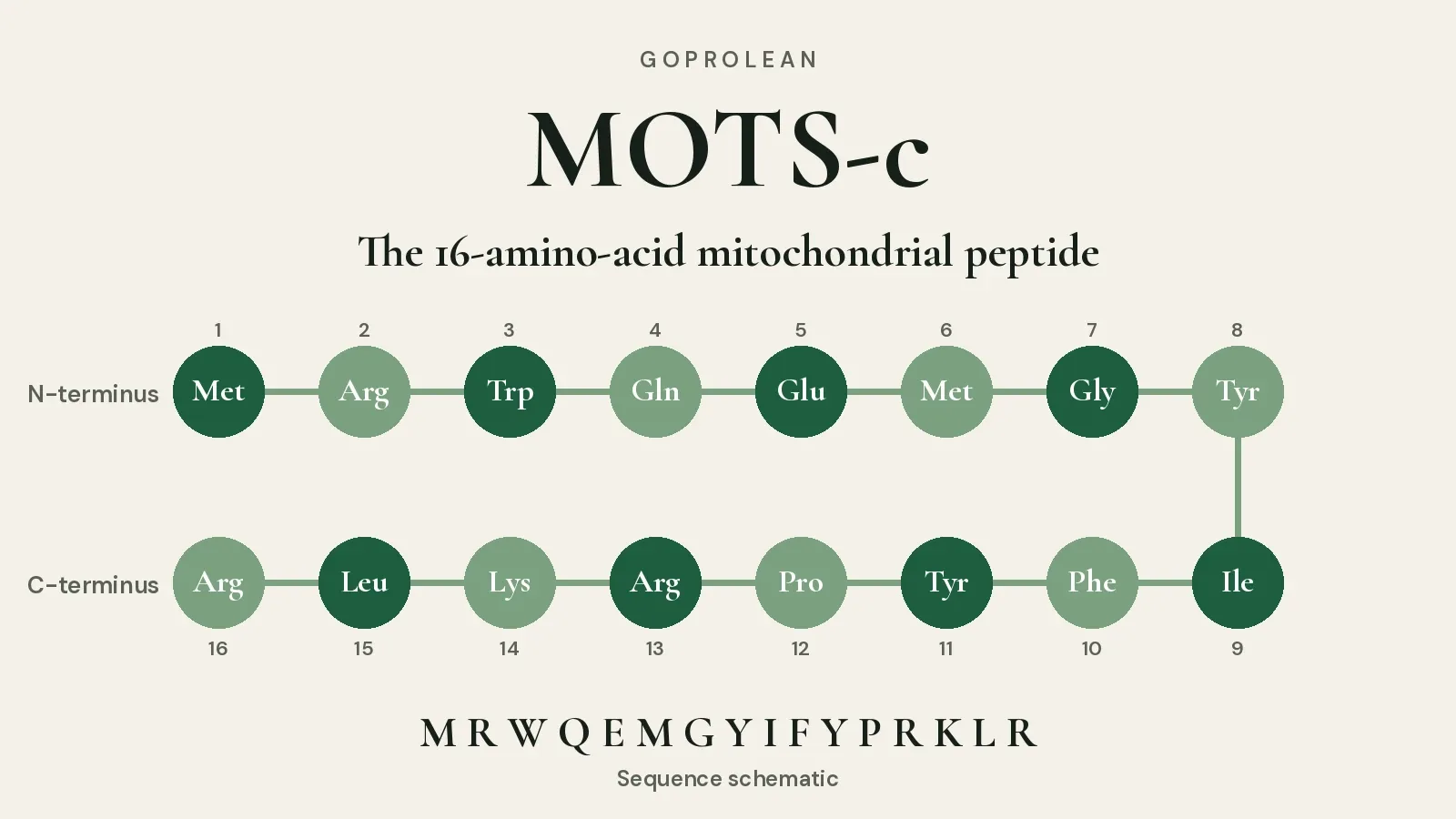
- MOTS-c is a 16-amino-acid peptide encoded in mitochondrial DNA. The body makes it naturally.
- In mice, MOTS-c prevented diet-induced obesity and age-related insulin resistance.
- Older mice given MOTS-c ran about twice as long as untreated mice, and a session of exercise raised MOTS-c in human muscle almost 12-fold.
- In a placebo-controlled trial, a MOTS-c analog lowered liver enzymes and blood glucose in adults with fatty liver disease and was well tolerated.
- In July 2026 an FDA advisory committee voted to recommend allowing pharmacies to compound MOTS-c, and in October 2026 HHS issued an interim policy that allows it under set conditions.
- MOTS-c is not FDA-approved. Through Goprolean it is available only after a licensed clinician's evaluation and prescription, where state law allows.
Goprolean offers a clinician-reviewed MOTS-c care-plan option, combining individualized evaluation, medication when prescribed, and communication with your clinician through the member portal.
What is MOTS-c?
MOTS-c is a 16-amino-acid peptide encoded within mitochondrial DNA. It belongs to a group called mitochondrial-derived peptides, which researchers study for their roles in communication between mitochondria and other parts of the cell.
The name stands for "mitochondrial open reading frame of the 12S rRNA-c." More practically, scientists are interested in how this peptide helps the body respond to metabolic demands such as exercise and changes in diet.
A foundational 2015 study in Cell Metabolism identified MOTS-c and found that its main target appears to be skeletal muscle, where it activates AMPK, a cellular energy sensor that is also switched on by exercise. The findings helped establish mitochondrial-derived peptides as an area of metabolic research. Lee and colleagues, 2015
An important distinction runs throughout this research: studying a peptide naturally present in the body is different from establishing the benefits of administering it as medication.
Why are researchers studying MOTS-c and metabolism?
Metabolism involves the processes through which cells use and store energy. Researchers have investigated whether MOTS-c influences some of the signaling pathways involved.
In the 2015 study, MOTS-c treatment in mice prevented both age-dependent and high-fat-diet-induced insulin resistance, and it prevented diet-induced obesity under the study's experimental conditions. These were animal findings, not evidence that MOTS-c produces weight loss or treats insulin resistance in people. Original study
A subsequent mouse study found that MOTS-c regulated circulating metabolites and enhanced insulin sensitivity, adding further clues about how the peptide may influence metabolic pathways. 2019 metabolic study
MOTS-c, exercise and physical capacity
A 2021 study in Nature Communications connected MOTS-c with exercise in both people and mice. Reynolds and colleagues, 2021
- In people: in 10 healthy young men, a session of stationary cycling raised MOTS-c levels in skeletal muscle 11.9-fold, and levels in the blood rose about 1.5- to 1.6-fold. The authors described MOTS-c as an exercise-induced, mitochondrial-encoded regulator.
- In older mice: after two weeks of MOTS-c treatment, old mice ran about twice as long and 2.16 times as far as untreated old mice. Seventeen percent of treated old mice reached the fastest running stage, compared with none of the untreated group, and they outperformed untreated middle-aged mice.
- Late in life: when treatment began in very old mice and was given three times a week, it improved grip strength, stride length and walking performance.
- In muscle cells: MOTS-c roughly doubled the survival of muscle cells under metabolic stress in the laboratory.
The human part of this study measured the body's own MOTS-c during exercise; the treatment results come from mice. Together they explain why MOTS-c is studied as a possible link between mitochondria, exercise and healthy aging.
What does human research tell us?
Most human research so far measures the body's own MOTS-c levels, for example during exercise, rather than giving MOTS-c as a treatment.
The most advanced human testing has involved CB4211, an analog of MOTS-c developed by CohBar. In a randomized, double-blind, placebo-controlled Phase 1a/1b trial reported in 2021, 20 adults with obesity and fatty liver disease received daily CB4211 or placebo for four weeks. Compared with placebo, CB4211 lowered the liver enzyme ALT by 21% (versus a 4% rise on placebo), lowered AST by 28% (versus 11%), and lowered blood glucose by 6%. The company reported that CB4211 was well tolerated, with no serious adverse events. CB4211 trial results
CB4211 is a modified version of MOTS-c rather than MOTS-c itself, and these were company-reported topline results. In its 2026 scientific evaluation, FDA reported that it had not identified publicly available clinical studies evaluating administration of MOTS-c-related bulk drug substances to humans. FDA scientific review
For anyone considering potential MOTS-c benefits, these findings and open questions belong in the clinical conversation alongside personal goals and established care options.
Exploring MOTS-c through Goprolean
Goprolean is a LegitScript-certified telehealth platform connecting members with independent licensed healthcare providers.
Its medications are offered through complete care plans. The displayed plan price includes clinician intake and evaluation, prescribing when clinically appropriate, labs if needed, and medication when prescribed.
You can review current options on the Goprolean MOTS-c care-plan page. A clinician assesses your circumstances before making a prescribing decision; purchasing a plan does not guarantee a prescription.
Your care continues through the Goprolean member portal, where you can:
- Complete your intake: Share your history, symptoms, current medications, and treatment goals.
- Communicate with your clinicians: Ask questions and discuss your care.
- Check in for refills: Complete the required refill check-in and clinician review.
When a compounded medication is prescribed, a licensed pharmacy prepares and dispenses it. Eligibility and availability vary by location and clinical circumstances.
Questions to bring to your clinician
Interest in metabolic research can be a useful starting point for a more specific health conversation. Consider discussing:
- What symptoms or health concerns prompted your interest?
- What might explain those concerns, and is further evaluation appropriate?
- Which established treatments or lifestyle changes address your needs?
- What evidence applies to any proposed medication?
- How would your clinician monitor treatment and decide whether to continue?
A thoughtful evaluation connects your questions about emerging science with your individual medical circumstances.
New to peptides? Start with Peptides Explained, our guide comparing all four peptides.
For more peptide research, see our guide to BPC-157 research and our guide to Epitalon and telomere research.
MOTS-c safety and regulatory status in 2026
MOTS-c's safety as an administered treatment in humans remains insufficiently characterized. A peptide's natural presence in the body does not establish the safety of a manufactured injectable formulation. FDA scientific review
On July 23, 2026, the FDA's Pharmacy Compounding Advisory Committee voted 8 to 6, with one abstention, to recommend adding MOTS-c to the list of bulk substances that 503A pharmacies may use. The recommendation is advisory; FDA makes the final decision through rulemaking. Advisory committee vote
In October 2026, HHS issued an interim enforcement-discretion policy that allows 503A pharmacies to compound MOTS-c acetate, by subcutaneous or intramuscular injection, while that rulemaking proceeds. Its conditions include a single-active-ingredient formulation, FDA-registered ingredient sourcing with quality documentation, and patient-specific prescriptions. Enforcement discretion does not constitute FDA approval or establish safety and effectiveness. HHS policy
Federal enforcement discretion does not override applicable state law. Prescribing and dispensing remain subject to state medical and pharmacy requirements, and availability may vary by state.
LegitScript has said that offering a peptide covered by the policy, in line with its conditions, should not by itself prevent a business from being certified. LegitScript's peptide guidance
Frequently asked questions
What is MOTS-c?
MOTS-c is a 16-amino-acid peptide encoded in mitochondrial DNA. The body makes it naturally, and researchers study it as a signal between mitochondria and the rest of the cell that helps regulate metabolism.
What does MOTS-c research show?
In mice, MOTS-c prevented diet-induced obesity and age-related insulin resistance, and older mice given MOTS-c ran about twice as long as untreated mice. In people, a session of exercise raised MOTS-c levels in muscle almost 12-fold. Most treatment research so far has been in animals.
Has MOTS-c been tested in people?
A MOTS-c analog called CB4211 was tested in a randomized, placebo-controlled trial. In 20 adults with obesity and fatty liver disease, four weeks of treatment lowered the liver enzymes ALT and AST and blood glucose compared with placebo, and it was well tolerated. MOTS-c itself is not FDA-approved.
How can I get MOTS-c through Goprolean?
Choose a MOTS-c care plan, then complete your medical intake in the Goprolean member portal. A licensed clinician reviews it, and if the clinician decides treatment is appropriate, the prescription is filled by a licensed compounding pharmacy. Purchasing a plan does not guarantee a prescription.
Explore your options with a clearer understanding
MOTS-c research highlights the growing scientific understanding of mitochondria, exercise, cellular signaling and metabolism, and explains why the peptide attracts attention.
Goprolean brings care-plan information, individualized clinician evaluation, and ongoing communication with your clinician into one experience. Bring your goals and questions to a licensed clinician.
Explore Goprolean's MOTS-c complete care plans →
Medical information: This article is educational and does not provide individualized medical advice. MOTS-c is not FDA-approved, and its clinical benefits and long-term safety as a treatment in humans have not been established. Independent licensed clinicians make all prescribing decisions. Goprolean's LegitScript certification does not constitute FDA approval of any medication. Availability depends on location and clinical eligibility.
References
1. Lee C, Zeng J, Drew BG, et al. The mitochondrial-derived peptide MOTS-c promotes metabolic homeostasis and reduces obesity and insulin resistance. Cell Metabolism. 2015;21(3):443–454. doi:10.1016/j.cmet.2015.02.009. Evidence type: original cell and animal research.
2. The mitochondrial-derived peptide MOTS-c is a regulator of plasma metabolites and enhances insulin sensitivity. Physiological Reports. 2019;7(13):e14171. Evidence type: original animal research.
3. Reynolds JC, et al. MOTS-c is an exercise-induced mitochondrial-encoded regulator of age-dependent physical decline and muscle homeostasis. Nature Communications. 2021;12:470. doi:10.1038/s41467-020-20790-0. Evidence type: human exercise measurements and mouse treatment studies.
4. CohBar, Inc. CohBar Announces Positive Topline Results from the Phase 1a/1b Study of CB4211 Under Development for NASH and Obesity. August 10, 2021. Evidence type: company-reported results of a randomized, placebo-controlled trial of a MOTS-c analog.
5. U.S. Food and Drug Administration. MOTS-c-related bulk drug substances: scientific evaluation for the July 23–24, 2026 Pharmacy Compounding Advisory Committee meeting. Source type: scientific and regulatory review; not a product approval.
6. Healio. FDA committee recommends looser restrictions for several peptides. July 24, 2026. Source type: news report of the advisory committee votes.
7. U.S. Department of Health and Human Services. Enforcement Discretion Policy Regarding 503A Compounding Using Certain Peptide Bulk Drug Substances. October 2026. Source type: conditional interim compounding policy.
8. LegitScript. HHS's Peptide Compounding Policy: What Healthcare Businesses Need to Know. November 2, 2026. Source type: certification and policy guidance.
More in Research

November 24, 2026
How commercial peptides are safely compounded
A clear look at how compounding pharmacies prevent contamination, test for sterility and endotoxins, and signal quality for injectable peptides.

November 16, 2026
Peptides Explained: What They Are and What the Research Shows
A guide to peptides and peptide therapy: what BPC-157, Epitalon, MOTS-c and PT-141 research shows, and how Goprolean's clinician-reviewed care plans work.
November 16, 2026
Epitalon: Understanding the Science Behind Cellular-Aging Research
What Epitalon research shows, from telomere studies in human cells to animal lifespan findings and the 2026 FDA advisory vote, and how Goprolean's care plans work.