
Switching From Semaglutide to Tirzepatide, and Back: Conversion Chart
Published October 1, 2026 · 10 min read

People switching from semaglutide to tirzepatide, or from tirzepatide back to semaglutide, usually go looking for a dose conversion chart: a table that says "this much of one equals that much of the other". It is a reasonable thing to want. It is also something that does not officially exist, in either direction.
This page covers what does exist, what it is based on, and how a prescriber actually handles the switch.
The short version. There is no official semaglutide to tirzepatide conversion chart, and none from tirzepatide to semaglutide either. They are different molecules, and the FDA-approved prescribing information for each one starts everyone at the same low dose, whatever they took before. Charts published by clinician groups list rough "comparable" doses, and the cautious way to use them is to start one to two levels lower than they suggest. Your prescriber sets your dose. Do not convert it yourself.
Is there a semaglutide to tirzepatide conversion chart?
Not an official one. The FDA-approved prescribing information for tirzepatide says treatment starts at 2.5 mg once a week for four weeks, and that the dose can then go up in 2.5 mg steps, no faster than every four weeks. It gives no instruction for people coming from semaglutide and no conversion table. It also says tirzepatide should not be taken together with a GLP-1 medication. That label covers the FDA-approved product. Compounded tirzepatide is not FDA-approved, and its dose is set by the prescriber.
The reason is the molecules. Semaglutide acts on one receptor, GLP-1. Tirzepatide acts on two, GLP-1 and GIP. A milligram of one is not a fraction of a milligram of the other, in the way that two strengths of the same drug would be. Nobody has run the kind of trial that would establish a true equivalent dose.
Semaglutide to tirzepatide: what the published charts list
Charts do circulate, mostly written by clinician groups for diabetes care. One widely shared chart lists these weekly doses as roughly comparable. The third column shows what "one to two levels lower" works out to, which is the cautious reading described below.
Three things to know before reading anything into this table. It is an approximation, not a tested equivalence. It was built for diabetes care and stops at 2 mg of semaglutide. And it is information for a conversation with your prescriber, not a dosing instruction.
"Semaglutide and tirzepatide are different molecules, so there is no true semaglutide to tirzepatide conversion chart, in either direction. When a patient is switching from semaglutide to tirzepatide, or from tirzepatide back to semaglutide, I would rather restart at the low starting dose and build up. If a dose conversion is used at all, I go one to two levels below what the charts suggest. A few extra weeks costs far less than a bad run of side effects."
What "one to two levels down" means
Tirzepatide comes in six weekly dose levels: 2.5, 5, 7.5, 10, 12.5 and 15 mg. "One to two levels down" means taking the dose a chart lists as comparable and stepping back one or two levels from it. A chart that says 10 mg becomes 5 or 7.5 mg. A chart that says 7.5 mg becomes 2.5 or 5 mg. Nothing goes below the starting dose, so for people coming from the lower semaglutide doses, the cautious conversion and a plain restart end up in the same place.
Tirzepatide to semaglutide conversion
The same logic applies in the other direction. The FDA-approved prescribing information for semaglutide starts at 0.25 mg once a week for four weeks and steps up from there, to 0.5, 1 and then 2 mg, with at least four weeks on each. It gives no conversion from tirzepatide.
Read in reverse, the same published chart gives the table below. The semaglutide levels are the ones the chart uses: 0.25, 0.5, 1 and 2 mg.
The same cautions apply. This is an approximation built for diabetes care, and it is not a dosing instruction. If you are moving from tirzepatide to semaglutide, expect your prescriber to restart low, not to match where you were.
What the evidence shows
The best direct evidence is a study called SURPASS-SWITCH-2, published in Endocrine Practice in 2024. About 150 adults with type 2 diabetes who were stable on a GLP-1 medication, a little over half of them on semaglutide between 0.5 and 2 mg, were moved straight to tirzepatide 5 mg, whatever dose they had been taking. Over twelve weeks, about 13 percent had stomach side effects. Most were mild, and two people stopped because of them.
That tells us a direct move to a low dose is generally tolerated. It does not tell us that higher "matched" doses are safe to start on, and it was a diabetes study, not a weight-management one. A 2025 systematic review of switching studies described the overall evidence as limited, with small studies and no comparison groups. The trial evidence is on moving to tirzepatide. In the other direction it is thinner still.
How a switch usually works
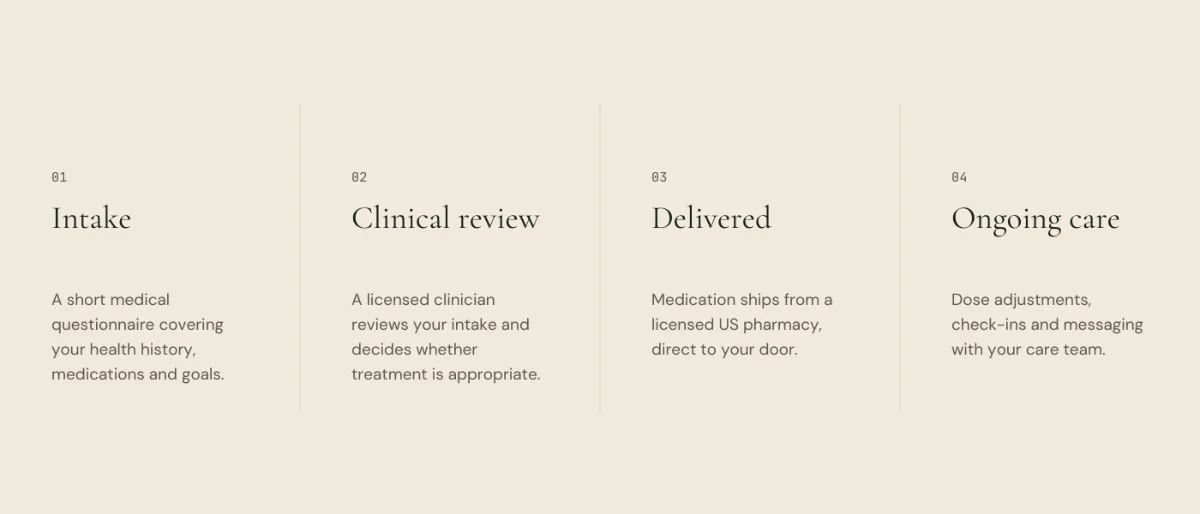
- You tell your prescriber what you take now, at what dose, for how long, and what side effects you have had.
- Your prescriber decides the starting dose of the new medication. That may be the standard starting dose or a conservative step above it.
- The two medications do not overlap. The first dose of the new one is usually taken on the day your next dose of the old one would have been due.
- The dose goes up in steps, with time on each step, guided by how you respond and how you feel.
- You report side effects early, so the pace can be slowed if needed.
Why not just match the dose?
Because the cost of starting too high is paid in side effects. Nausea, vomiting, diarrhea and constipation are the common ones with both medications, they are dose-related, and they are most likely just after starting or stepping up. Having tolerated one does not guarantee you will tolerate a matched dose of a different molecule.
Starting low costs a few weeks. Starting too high can cost the treatment, because people who feel ill stop taking it.

Frequently asked questions
Is there an official semaglutide to tirzepatide conversion chart?
No. The FDA-approved prescribing information for tirzepatide gives no conversion from semaglutide. It gives one starting dose for everyone. The charts you find online are approximations, mostly built for diabetes care.
What dose of tirzepatide is equal to 1 mg of semaglutide?
There is no proven equal dose, because they are different molecules. One widely shared comparison chart lists 7.5 mg as roughly comparable. Many prescribers start well below that, and the approved label starts everyone at 2.5 mg.
Is there a tirzepatide to semaglutide conversion chart?
Not an official one. The same published charts can be read in reverse, and the same caution applies: restart at the low starting dose, or go one to two levels below what the chart lists.
Do I have to start at the lowest dose when I switch?
That is what the approved labels say, and it is the most cautious option. Some prescribers start a little higher for people who tolerated their previous medication well. Your prescriber decides based on your history.
How long should I wait between my last dose of one and my first dose of the other?
The two are not taken together. Published guidance is to wait a week after the last weekly dose, which usually means taking the first dose of the new medication on the day the next dose of the old one would have been due. Confirm the timing with your prescriber.
Will I get side effects again when I switch?
You might. Stomach side effects such as nausea are most common after starting or increasing a dose. In one study where people switched straight to 5 mg of tirzepatide, about 13 percent had stomach side effects, most of them mild.
Goprolean prescribes compounded semaglutide and compounded tirzepatide online. If you are switching, say what you take now when you complete your intake. A licensed physician reviews it and sets your starting dose.
See tirzepatide · See semaglutide · Compare the two · Not sure which? Six questions, about ninety seconds
Sources
- FDA-approved prescribing information for tirzepatide, Dosage and Administration.
- FDA-approved prescribing information for semaglutide, Dosage and Administration.
- GLP-1 dose comparisons chart, Wisconsin Academy of Family Physicians.
- Switching to Tirzepatide 5 mg From Glucagon-Like Peptide-1 Receptor Agonists (SURPASS-SWITCH-2), Endocrine Practice, 2024.
- Addressing the Shortage of GLP-1 RA and Dual GIP/GLP-1 RA-Based Therapies: A Systematic Review, Diabetology, 2025.
This article is general health information and is not medical advice for any individual. Compounded medications are not FDA-approved and are not reviewed by the FDA for safety or effectiveness. Prescriptions are issued only after a medical intake is reviewed by a licensed physician, who may determine that treatment is not appropriate; in that case the order is cancelled and you are refunded in full. Individual results vary. Goprolean is operated by Prolean Wellness Management LLC, owner of Prolean Wellness in Scottsdale, Arizona. Care is provided by independent licensed clinicians.
More in How-To
September 21, 2026
How to inject Testosterone
The four sites worth using, the two to avoid, what gauge and length to reach for, and how to do it without the lump, the bleed or the ache that puts men off week two.

September 21, 2026
How to Get TRT Online: Cost, Labs and Timeline
Most men who want TRT get stuck at the same three places: whether they qualify, what it actually costs, and how long before anything changes. Here is the answer to each.