
How to inject semaglutide safely at home
Published October 21, 2026 · 11 min read
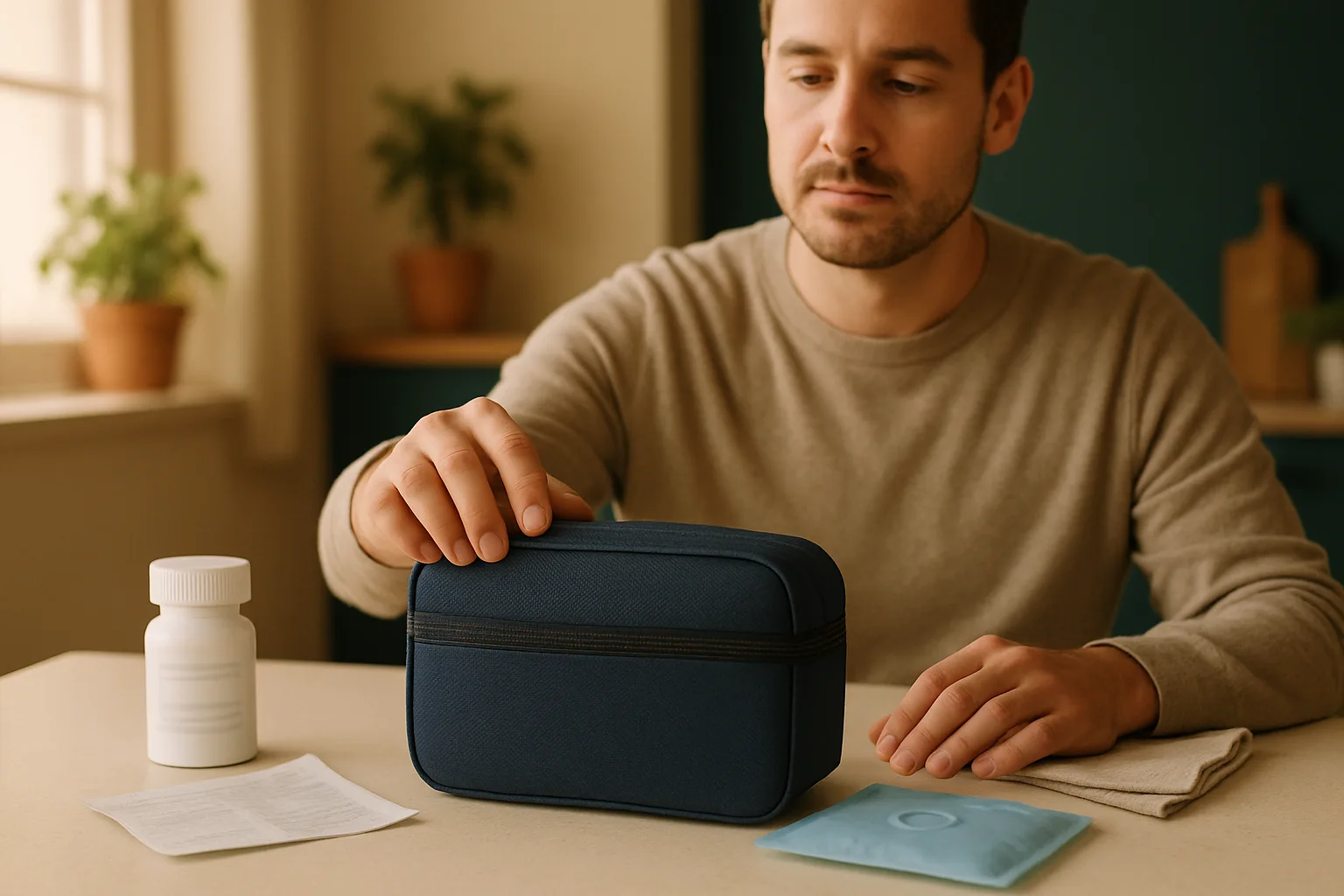
The box arrives, and the instructions look like they were written for someone who's done this before. You aren't that someone yet. That's the whole problem.
So the needle sits on the counter, and each week the same questions come back: is this the right spot, did I hold it long enough, where does the used needle go? Guessing costs you time and quiet worry. And a spot you keep hitting out of habit costs you more than that.
Injection technique is learnable, and it's worth learning properly. A meta-analysis of insulin injectors found that incorrect site rotation was the strongest contributor to lipohypertrophy, with roughly nine times the odds [1].
This guide covers site mapping, step-by-step technique, missed doses, storage and travel. No dosing, just the skills.
Unpack your delivery kit and set up a clean space
Open the parcel on a clear, well-lit counter and check every item against the packing slip before you touch anything else. Knowing what's in front of you takes most of the nerves out of the first injection.
Your kit is built so you don't have to improvise. Here's what you'll typically find and what each piece does:
- Pen or vial device holds your medication and delivers it under the skin.
- Needles, if they ship separately, are single-use and go on only when you're ready to inject.
- Alcohol swabs clean the skin and the device's connection point before each use.
- A sharps container holds used needles and pen tips safely until you can dispose of them properly.
- Instructions and labels show the medication name, storage details and expiry date, so give them a read.
Set aside a small tray that lives in one spot, so your supplies are always in the same place. Clear the surface, wash your hands, and lay out the device, a fresh needle, a swab and your sharps container within easy reach.
Don't open the needle or attach anything until the medication is at the right temperature and you're ready to go. Warm medication stings less. A calm, prepared space also makes the routine feel less clinical.
If something in the parcel is missing, damaged or doesn't match your order, it's worth flagging before your first injection so it can be put right.
Why your starting point is built around your health, not a chart
Your starting dose isn't a template. It's a judgment made about your body, and clinical teams weigh several factors together before deciding where your protocol begins.
They look at your metabolic goal, your weight and health history, and any conditions that shape how your body handles a GLP-1 medication. Kidney and liver function matter here, because these organs influence how a drug moves through your system.
Your current prescriptions and supplements get reviewed too. Some diabetes medicines interact with GLP-1 medications, and that's worth knowing before you start.
The goal isn't finding the "right" dose for everyone. It's designing a starting point that fits your health, not a chart.
All of this is why your intake matters. The more complete and accurate your health information is, the more closely a protocol can be built around you.
If something changes — a new prescription, a new diagnosis, a side effect that worries you — that's information worth passing on. Sharing it early keeps your plan aligned with your actual health.
Map your injection sites and rotate them weekly
Where you inject matters less than how often you move it around. The three standard subcutaneous zones all work well. But staying in one spot is the habit most likely to cause trouble down the line.
Abdomen, thigh, and upper arm landmarks
Each zone gives you a broad, easy-to-reach area of fatty tissue just under the skin.
- Abdomen: anywhere across the belly, staying at least a couple of finger-widths away from the navel and clear of scars or stretch marks.
- Front of thigh: the soft area on the upper outer half, where you can pinch a fold of tissue comfortably.
- Upper arm: the outer back of the arm, usually easiest with help or a mirror.
Pick a site you can see and reach steadily. Consistency of technique beats hunting for a "perfect" spot.
Prevent tissue irritation with systematic rotation
Repeatedly injecting the same small patch can cause lipohypertrophy, a lumpy buildup of fatty tissue under the skin. In a meta-analysis of over 7,000 people receiving insulin injections, ultrasound picked up lipohypertrophy in about 70% of them[2]. The scan-based rate was far higher than what many people would notice by touch alone.
Rotation is the biggest lever you control. A second meta-analysis found that incorrect site rotation carried the strongest odds of lipohypertrophy of any risk factor studied, well ahead of needle reuse and longer treatment duration[1].
Lumps aren't just cosmetic. In a small randomized trial of 13 people with type 1 diabetes, injecting into lipohypertrophic tissue reduced insulin absorption and effect.
It also made absorption far more variable than injecting into normal tissue[3]. That variability is why rotating is worth the small effort.
Move at least a finger-width from your last spot each week, and cycle through zones rather than camping in one. A simple grid drawn on your abdomen or a note in your phone works fine.
What pharmacokinetic trials show about injection sites and side effects
Steady-state exposure is achieved following 4 to 5 weeks of once-weekly administration.[4] The label also describes a roughly one-week elimination half-life and semaglutide staying in circulation for about five weeks after the last dose.[4]
Here's the honest part: that same source doesn't directly compare abdomen, thigh and upper arm absorption, or show that tolerability changes by site. Research hasn't measured whether one of those sites makes you feel meaningfully different.
Pick the site you can reach and rotate reliably. Absorption is high across the board, and the comparison data between sites isn't there.
Inject step by step, from prep to disposal
A calm, unhurried routine matters more than speed here. Set everything out within reach, then wash your hands with soap and water and dry them fully.
Prepare the skin and warm the medication
Clean the injection site with an alcohol swab and let it air dry completely. Injecting into wet alcohol stings, and dry skin gives you a better grip for the pinch.
If your device has been in the fridge, let it come closer to room temperature first. Cold medication can feel sharper going in.
Insert the needle, hold, and dispose safely
- Pinch a fold of skin and fatty tissue between your thumb and fingers, keeping your muscle relaxed.
- Insert at the angle your device's instructions specify, moving in a smooth, steady motion rather than a jab.
- Hold the needle still for the count your instructions give before withdrawing, which gives the medication time to settle.
- Release the pinch as you withdraw, then press a clean swab gently on the spot without rubbing.
- Drop the needle straight into your sharps container and close the lid before you tidy anything else.
If you feel lightheaded beforehand, sit down and take a few slow breaths before starting.
Sibling guide: how to inject testosterone at /learn/how-to/how-to-inject-testosterone covers the same technique family.
Handle missed injections, refrigeration, and travel without drama
Missed injection days and travel weeks happen, and neither usually means starting over. The one thing worth protecting is the medication itself.
Most GLP-1 pens and vials are kept refrigerated before first use, though many tolerate a limited stretch at room temperature once in use. Use-by dates and temperature tolerances differ by product, so check the label or the pharmacy insert that arrived with your kit rather than assuming. If the medication has been frozen, left in a hot car, or sat out well past what the label allows, replace it rather than inject it and hope.
When you're unsure whether a dose missed by a day or two should be taken late or skipped, a quick message can settle it. Keep the rest of the routine steady while you wait.
Travel is manageable with a little planning. Keep the medication in your carry-on rather than checked luggage, where cargo holds get cold, and bring the pharmacy label so security screening is straightforward. A small insulated pouch with a cold pack handles most short trips without trouble.
For longer delays or a power cut, don't open the fridge door repeatedly. Keep the kit closed and insulated, and check the storage guidance that came with it once you're back on steady power.
Build a weekly routine you won't forget
A weekly injection is easy to forget once the novelty wears off, so give it a fixed home in your week rather than leaving it to chance. Same day, same time, same spot in your routine. That's the whole trick.
Pick a time when you'll be home and settled, and anchor the dose to something you already do — a Sunday evening, a cup of coffee, whatever repeats. Then log it.
- Log the basics — date, time and which site you used, so rotation stays honest.
- Keep a written record — a notes app or paper page beats memory when life gets busy.
- Note how you feel — brief notes on appetite and any side effects give patterns something to work with.
- Set a backup alarm — a repeating reminder you'll actually see, plus one for travel weeks.
Flag anything that worries you and pass it to your Goprolean care team. They can answer supply, storage and technique questions you meet along the way.
There's a whole family of self-injection skills you'll recognise, and the testosterone injection guide covers the same techniques from a different angle.
Once you're ready to look at what's available, you can view semaglutide options and see how the published price works.
Related reading
Most of what makes a GLP-1 injection go smoothly happens before and after the needle, not during it. Knowing what's in the kit, where to rotate, how to store it, and what to do after a missed dose turns a nervous first try into routine.
That's the whole point of a safety-first walkthrough: fewer surprises, fewer wasted pens, and a clearer line between normal and time to reach out. If something doesn't look or feel right, your Goprolean care team is the first call, not the last.
Ready to see what the process looks like from the inside? View semaglutide options.
Frequently asked questions
Where is the least painful place to inject a GLP-1?
The least painful spots are areas with a little fat under the skin, like your belly, upper thighs or the back of your upper arms. Fat under the skin is where subcutaneous injections are meant to go, and such areas tend to be less tender.
Why is there a tiny drop of liquid on my skin after injecting?
A tiny drop is normal and usually means a little medication stayed on the skin's surface or the needle left a trace as it came out. It doesn't mean the dose failed. If you see a lot of liquid or a wet spot, mention it to your care team.
Can I inject my GLP-1 medication straight from the refrigerator?
Follow the storage and handling instructions that come with your device, since cold liquid can feel more uncomfortable going in. Letting it sit at room temperature for a short time is a common comfort step.
What should I do if I see an air bubble in my device?
Small air bubbles are common and usually harmless in a pen or syringe. Don't shake the device to get rid of them. If a bubble looks large or the device seems faulty, contact your care team.
When does an injection site reaction need medical attention?
A reaction that's spreading, painful, hot to the touch, oozing, or not settling after a few days is a sign to stop and get it looked at. Mild redness or a small bump often fades. Rotating sites matters, because incorrect site rotation was the strongest contributor to lipohypertrophy in a meta-analysis of insulin-treated diabetes. A reaction that keeps coming back deserves a check-in.
References
- Risk factors for Lipohypertrophy in People With Insulin-Treated Diabetes: A Systematic Meta-Analysis. Journal of diabetes science and technology, 2026. PMID 40109173.
- Prevalence of insulin injection-induced lipohypertrophy detected by ultrasound: a systematic review and meta-analysis. BMC public health, 2026. PMID 41593584.
- Insulin Injection Into Lipohypertrophic Tissue: Blunted and More Variable Insulin Absorption and Action and Impaired Postprandial Glucose Control. Diabetes care, 2016. PMID 27411698.
- Semaglutide prescribing information (FDA label). FDA label via DailyMed, 2026.
The clinical studies referenced in this article evaluated FDA-approved semaglutide and tirzepatide products. Compounded medications, including those prescribed through Goprolean, are not FDA-approved and have not been reviewed by the FDA for safety, effectiveness or quality, and results seen in those studies may not be the same with a compounded preparation. Individual results vary. This article is educational and is not medical advice. Prescriptions are issued only after a licensed physician reviews your medical intake.
More in How-To

October 21, 2026
Relieve nausea from semaglutide: practical tips
Nausea on semaglutide is common but often manageable. This guide gives timelines, daily habits, foods to avoid, evidence-backed remedies like ginger and vitamin B6, and when to contact your care team.
October 1, 2026
Switching From Semaglutide to Tirzepatide, and Back: Conversion Chart
People switching between semaglutide and tirzepatide look for a dose conversion chart. There is no official one in either direction. Here is what exists, what it is based on, and how a prescriber handles the switch.
September 21, 2026
How to inject Testosterone
The four sites worth using, the two to avoid, what gauge and length to reach for, and how to do it without the lump, the bleed or the ache that puts men off week two.